
As China emerges as a global hub for advanced ophthalmology, more international patients are choosing its state-of-the-art clinics for procedures like SMILE, LASIK, and ICL implantation. This guide breaks down everything you need to know—from technological advantages to post-op care—for a seamless experience.
1. Why Choose China for Laser Eye Surgery?
Unmatched Cost-Effectiveness
China offers world-class procedures at 30-50% of Western prices. For example:
- SMILE Pro(全飞秒): ¥15,000-25,000 (US$2,100-3,500)
- FS-LASIK (半飞秒): ¥10,000-18,000 (US$1,400-2,500)
- ICL Implantation (晶体植入): ¥30,000-45,000 (US$4,200-6,300)
These prices include pre-op exams, surgery, and basic post-op follow-ups, making it an affordable option without compromising quality.
Cutting-Edge Technology & Expert Surgeons
Chinese hospitals boast the latest equipment:
- Zeiss VisuMax for SMILE (small incision lenticule extraction)
- Alcon EX500 for ultra-fast LASIK ablation (0.5 seconds per diopter)
- Centurion Vision System for premium ICL surgeries
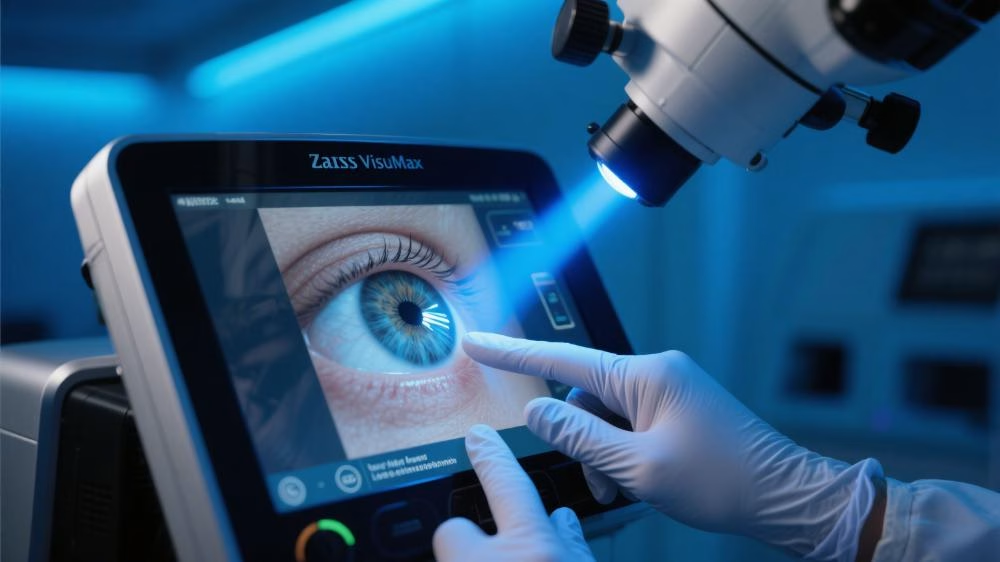
Surgeons here average 10,000+ procedures annually, with top clinics like Peking University Third Hospital performing over 20,000 vision corrections yearly. Many specialists hold international certifications (e.g., American Academy of Ophthalmology) and publish in journals like Ophthalmology.
Minimal Waiting Times
Unlike Western clinics with 3-6 month waitlists, most Chinese hospitals offer:
- Pre-op exams within 1-3 days (with online booking)
- Surgery scheduling within 1 week of consultation
- Same-day follow-ups for standard procedures
2. Visa & Entry Process
Most laser eye surgery patients regain basic visual function within 7 days. For entry to China, we recommend the following visa policies:
Visa Type
- A tourist visa (L visa) is generally acceptable if the purpose is stated as “medical tourism.”
- For more complex eye conditions requiring extended treatment, a medical purpose visa (S2/S1) may be necessary. This requires a hospital invitation letter and proof of payment deposit.
Visa – Free Policies
- The 240 – Hour Transit Visa – Free Policy is available to citizens of 54 countries (e.g., Austria, United States, Canada).
- Citizens of certain countries (e.g., France, Singapore) may enjoy visa – free stays up to 30 days.
Please check China’s latest visa policies (including visa-free) here.
Sample 7-Day Surgery Itinerary
| Day | Task | Key Notes |
|---|---|---|
| 1 | Arrival + Pre-op tests | Carry translated medical records |
| 2 | Surgery (15–30 mins) | Arrange airport pickup; avoid driving |
| 3–4 | Recovery monitoring | Mandatory 24-hr follow-up; no screens |
| 5–6 | Final check + Sightseeing* | Sunglasses required outdoors |
| 7 | Departure | Exit before visa expiry |
3. Choosing China’s LASER Eye Surgery Hospitals
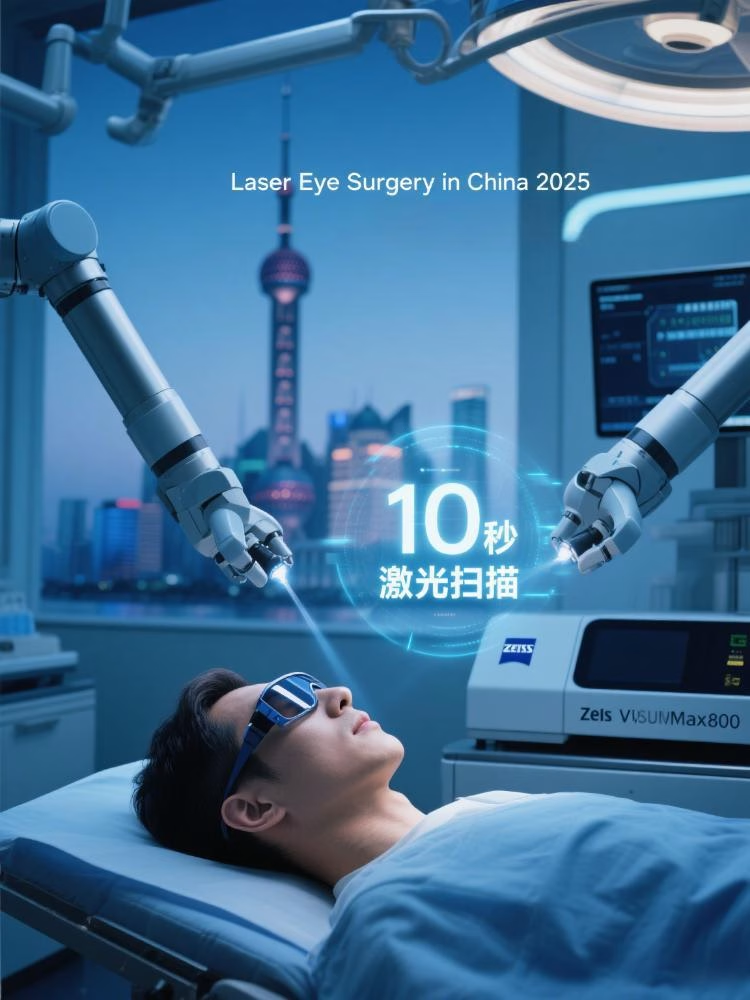
Criteria for Choosing a LASER Institution
- Accreditation and Certifications: Look for hospitals accredited by international organizations and certified by Chinese health authorities.
- Surgeon Credentials: Check the qualifications, experience, and track record of the surgeons.
- Patient Reviews and Testimonials: Read reviews and testimonials from previous international patients.
- Facilities and Technology: Ensure the hospital is equipped with modern facilities and advanced laser technology.
- Language Services: Choose a hospital that offers language services in your preferred language.
- Cost Transparency: Ensure the hospital clearly outlines all costs.
How Can International Patients Verify the Qualifications?
Step 1. Check the “Three Certificates and One Record”
Request the institution to provide:
- A photo of the original “Medical Institution Practice License”
- The “Physician Practice Certificate” of the operating surgeon
- The “License for the Configuration of Large – scale Medical Equipment” (if using imported laser devices)
- The “Record Table for Medical Aesthetic Projects” (which can be checked on the official website of the provincial health commission)
Step 2. Verification through Official Channels
- National Health Commission Official Website Inquiry: http://www.nhc.gov.cn → Access the “Medical Institution Inquiry” entry
- Local Health Commission Telephone Verification: For example, Beijing Health Commission: +86-10-12320 (Provide the full name of the institution for verification)
Step 3. Identify the “Certified Hospital” Mark
Legitimate institutions will display marks such as:
- Member Unit of the Chinese Medical Association Ophthalmology Branch
- Certified Institution by the International Society of Refractive Surgery (ISRS)
Top Recommended Hospitals (Public, Level 3, Grade A Hospitals in Beijing)
| City | Hospital Name | Hospital Introduction | Specialty | International Services |
| Beijing | Peking Union Medical College Hospital (北京协和医院) | A JCI-accredited, top-tier hospital with a century-long legacy, renowned for its ophthalmology department’s precision in refractive surgeries. | Customized LASIK, ICL implantation, SMILE (Zeiss VisuMax) | English-speaking coordinators, international insurance processing, multilingual medical records |
| Beijing | Peking University Third Hospital (北京大学第三医院) | A Class III Grade A hospital with an ophthalmology department performing over 20,000 vision corrections annually, including complex cases. | Wavefront-guided LASIK, corneal cross-linking, advanced ICL techniques | Preoperative consultations via WeChat/Alipay, translation apps during visits |
| Beijing | Beijing Tongren Hospital Affiliated to Capital Medical University (首都医科大学附属北京同仁医院) | A national leader in ophthalmology, operating the largest refractive surgery center in China, performing over 25,000 laser procedures yearly. | All-laser SMILE, PRK, customized LASIK for high myopia/astigmatism | English-speaking staff, real-time translation devices, global insurance partnerships |
| Beijing | China-Japan Friendship Hospital (中日友好医院) | A modern tertiary hospital with a focus on minimally invasive techniques, including bladeless LASIK and ICL for thin corneas. | SMILE, FS-LASIK (Alcon EX500), astigmatism correction | Online pre-screening for international patients, multilingual discharge instructions |
| Beijing | Chinese PLA General Hospital (301 Hospital) (中国人民解放军总医院 / 301 医院) | A military-affiliated hospital with state-of-the-art facilities, including a dedicated refractive surgery center using Zeiss and Alcon systems. | All-laser SMILE, femtosecond LASIK, complex ICL surgeries | Priority appointments, English medical reports, airport shuttle services |
| Shanghai | Eye & ENT Hospital of Fudan University (复旦大学附属眼耳鼻喉科医院) | A specialized Class III Grade A hospital ranked among China’s top 3 ophthalmology centers, pioneering advanced corneal and refractive surgeries. | SMILE, ICL V4c for high myopia, wavefront-guided LASIK | Pre-bookable international consultations (+86 21-6589-0923), English post-op care instructions |
| Shanghai | Shanghai Ninth People’s Hospital Affiliated to Shanghai Jiao Tong University School of Medicine (上海交通大学医学院附属第九人民医院) | A national clinical key specialty for ophthalmology, offering comprehensive refractive services with a focus on complex cases. | Customized LASIK, SMILE, toric ICL for astigmatism | Full-time interpreters, English consent forms, global insurance networks |
| Shanghai | Ruijin Hospital Affiliated to Shanghai Jiao Tong University School of Medicine (上海交通大学医学院附属瑞金医院) | A JCI-accredited hospital with a robust ophthalmology department, equipped with Centurion Vision System for premium ICL procedures. | SMILE, FS-LASIK, ICL implantation for thin corneas | International Patient Center with English staff, direct billing for overseas insurers |
| Shanghai | Zhongshan Hospital Affiliated to Fudan University (复旦大学附属中山医院) | A top-tier academic hospital integrating research and clinical excellence, offering personalized refractive solutions. | All-laser SMILE, topography-guided LASIK, ICL for presbyopia | Multilingual consultation platforms, English post-op follow-ups |
| Shanghai | Shanghai General Hospital (上海市第一人民医院) | A historic Class III Grade A hospital with a modern ophthalmology department specializing in advanced laser technologies. | SMILE, bladeless LASIK, combined procedures for complex cases | Online appointment system for foreign patients, English medical certificates |
| Guangzhou | Zhongshan Ophthalmic Center, Sun Yat-sen University (中山大学中山眼科中心) | The No. 1 ophthalmology hospital in China, designated as a WHO Collaborating Center for Eye Health, performing over 50,000 refractive surgeries annually. | SMILE, LASIK, ICL, pediatric myopia control with corneal reshaping | Free translation apps during visits, English-speaking coordinators, telemedicine follow-ups |
| Guangzhou | Guangdong Provincial People’s Hospital (广东省人民医院) | A leading public hospital with a comprehensive eye center offering advanced laser therapies, including SMILE and ICL. | All-laser SMILE, FS-LASIK, toric ICL for astigmatism | English consultation hotline (+86 20-8382-7812), international insurance assistance |
| Guangzhou | Nanfang Hospital Affiliated to Southern Medical University (南方医科大学南方医院) | A Class III Grade A hospital with a strong focus on minimally invasive refractive surgeries, using Zeiss VisuMax and Alcon platforms. | SMILE, PRK, ICL for high myopia/astigmatism | Preoperative assessments via email, English discharge summaries |
| Guangzhou | First Affiliated Hospital of Guangzhou Medical University (广州医科大学附属第一医院) | A modern tertiary hospital with a dedicated refractive surgery unit, providing personalized LASIK and SMILE procedures. | Wavefront-guided LASIK, SMILE, ICL for presbyopia | English-speaking staff, multilingual medication labels, airport transfer arrangements |
| Guangzhou | Sun Yat-sen Memorial Hospital, Sun Yat-sen University (中山大学孙逸仙纪念医院) | An academic medical center with a state-of-the-art ophthalmology department, offering advanced corneal and refractive surgeries. | SMILE, FS-LASIK, toric ICL for complex cases | Online booking for international patients, English post-op care guides |
4. Itinerary Planning (From Consultation to Recovery)
Pre – Surgery Arrangements
- Have an online consultation first. Then book flights to major Chinese cities and arrange accommodation in advance, arriving a few days before surgery.
During the Surgery Period
Follow the hospital schedule on surgery day. Recovery is usually quick, with most patients resuming normal activities within a few days.
Post – Surgery Sightseeing (Optional)
If well enough, explore local attractions like the Great Wall in Beijing or the Bund in Shanghai, but prioritize recovery and avoid straining your eyes.
Buffer Time
Plan an additional 2 – 3 days as buffer time to account for any unexpected delays, such as flight cancellations, surgical complications, or slower recovery than anticipated.
Logistics Arrangements
Book your flight tickets and arrange accommodation in China preferably near the hospital or clinic. Also, plan any sightseeing activities you wish to do during your stay in China, but keep in mind that you should avoid strenuous activities and excessive eye strain during the initial recovery period after the surgery.
Sample Schedule
| Day | Activity | Key Notes |
|---|---|---|
| – 30 | Virtual consultation | Send eye photos & medical history |
| – 7 | Book flights + hotel | Choose hospital – affiliated accommodation |
| 1 | Arrival in China; pre – op tests | Comprehensive eye exams; avoid contact lenses |
| 2 | Surgery (10 – 15 minutes per eye) | Local anesthesia; no overnight stay needed |
| 3 | Post – op check – up + discharge | Receive post – op kit (drops, protective glasses) |
| 4 – 5 | Local recovery | Avoid rubbing eyes; wear protective eyewear |
5. The Surgery: Step-by-Step
Procedure Comparison
| Technique | Best For | Recovery Time | Advantages | Considerations |
|---|---|---|---|---|
| SMILE Pro (全飞秒) | ≤1000° myopia, ≤500° astigmatism | 1-3 days | No flap, minimal dry eye | Longer laser time |
| FS-LASIK (半飞秒) | High myopia/astigmatism | 24 hours | Customizable | Flap risk (0.1% complication rate) |
| ICL Implantation(晶体植入) | ≥1200° myopia, thin corneas | 3-7 days | Reversible, preserves corneal tissue | Requires iris compatibility test |
Surgery Day Flow
- Pre – Op: Comprehensive eye exams, numbing eye drops.
- Laser Treatment:
- LASIK: Flap creation using femtosecond laser, followed by reshaping the cornea with excimer laser.
- Post – Op: Brief rest; protective eyewear provided.
- Anesthesia: Topical eye drops (no injections), patients remain awake
- Sensation: Mild pressure during laser application; no pain
- Duration: 10-15 minutes per eye for LASIK/ICL; 5-8 minutes for SMILE
6. Post-Op Care
Medical Guidance
Strictly adhere to the surgeon’s post – op care instructions, including proper eye care, regular medication intake, and attendance at all scheduled follow – up appointments, usually at 1 day, 1 week, 1 month, and 3 months post – surgery.
Critical Recovery Phases
| Timeline | Action Plan | Risks to Avoid |
|---|---|---|
| Day 1 | • Wear protective eyewear | Rubbing eyes; exposure to water/dust |
| Day 2 – 7 | • Gentle eye cleaning | Strenuous exercise; extended screen time |
| Week 2 – 4 | • Resume normal activities gradually | Contact sports; swimming |
| Month 3 | • Final visual acuity assessment | Eye strain from prolonged reading/screens |
Key Tips
- Avoid rubbing your eyes, swimming, and exposure to dust and pollutants for at least 1 – 2 weeks after surgery.
- Do not take flights for 2 – 3 days post – surgery, as changes in air pressure may affect the healing process of the eyes.
- Use recommended eye drops and wear protective eyewear as instructed.
- Follow a healthy diet rich in vitamin A and other nutrients to support eye recovery.
Emergency Support
Save the hospital’s emergency contact number and your country’s embassy or consulate phone number in case of any emergencies or urgent situations during your stay in China. It is also advisable to have a local contact or translator available to assist you in communicating with medical staff or dealing with any other issues that may arise.
7. Practical Tips
Language Support
While many top – tier hospitals and clinics in China have English – speaking staff members, language barriers may still exist during complex medical discussions or follow – up appointments. Bringing a translator or using translation apps may be helpful to ensure clear communication and understanding of the treatment process and post – op care instructions.
Payment Methods
- Credit cards (3% processing fee)
- Bank transfer (requires 5 – day advance)
- Avoid cash payments > $5,000
Insurance Note
“LASIK eye surgery is rarely covered by insurance. Purchase travel medical insurance covering surgical complications – e.g., infection or corneal issues.” – Dr. Wang Mei, Aier Eye Hospitalions.”
8. Cost Breakdown
Full Package Estimate
| Category | Cost (USD) | Includes |
|---|---|---|
| Surgery | $2,100 – $3,200 | SMILE Pro, pre-op scans |
| Meds | $50 – $100 | Eye drops, supplements |
| Accommodation | $300 (5 nights) | 4-star hospital partner |
| TOTAL | $2,450 – $3,400 |
Global Cost Comparison
| Region | SMILE (per eye) (USD) | LASIK (per eye) (USD) | ICL (per eye) (USD) |
|---|---|---|---|
| China | $2,100 – $3,500 | $1,400 – $2,500 | $4,200 – $6,300 |
| USA/Canada | $4,500 – $6,000 | $3,000 – $4,500 | $8,000 – $10,000 |
| UK/EU | €3,500 – €5,000 ($4,400 – $6,300) | €2,500 – €4,000 ($3,100 – $5,000) | €7,000 – €9,000 ($8,800 – $11,300) |
Conclusion
China offers a compelling combination of cutting-edge technology, affordable pricing, and patient-centric care for laser eye surgery. By following this comprehensive guide and making well-informed decisions, you can enjoy improved vision and explore China’s attractions with ease.
If you have any questions about taking Laser Eye Surgery in China or need customized medical tourism services, please feel free to contact us. Thank you!
Disclaimer:
This article provides general information about medical tourism for Laser Eye Surgery in China. It is not intended as medical advice or a substitute for professional consultation. International patients should conduct independent verification of hospitals, surgeons, and procedures, and consult qualified healthcare providers before making treatment decisions. China Medical Tourism Guide assumes no liability for actions taken based on this content.
